


Asbestos Removal ExpertsCertified on all types of sites
For more than 20 years, VALGO has been working on asbestos and lead removal projects all over France, including in the most complex environments.
Asbestos removal is an essential regulatory step for any renovation, demolition, rehabilitation or upgrade project for buildings constructed before 1997. As a Qualibat 1552 certified company, we work on industrial sites, public establishments, collective housing or complex infrastructures for the removal of materials containing asbestos, lead or other pollutants.
Our specialized teams carry out these operations on occupied or unoccupied sites, in constrained, isolated environments or those exposed to climatic hazards, in compliance with safety standards, waste traceability requirements, and imposed deadlines. We adapt our intervention methods to the nature of the building, the layout of the premises, and the specific health and technical challenges of each site.
Our asbestos removal solutionsSuitable for all types of buildings.
Our areas of intervention
- Interventions in industrial environments and/or occupied sites
- Interventions in high-rise buildings
- Work in operating hospitals
- Lead and asbestos removal from historical buildings
- Asbestos removal during ship maintenance
- Lead removal on bridges
- Liquid polyethylene sheeting
- Lead removal
- Heat-sealed containment

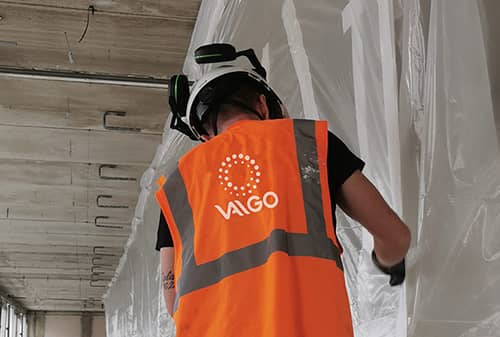
Our techniques implemented
- Asbestos removal / lead abatement
- Removal of Refractory Ceramic Fibers (RCF)
- Encapsulation / boxing
- Stripping and demolition
- Asbestos-related work (SS4)
Control, traceability and restitution
- Post-construction visual inspection (NF X46-021 standard)
- Dust monitoring during and at the end of the construction site
- Waste tracking with BSDD via Trackdéchets, disposal at approved centers (ISDD, vitrification, etc.)
THE VALGO ADVANTAGES
+ 300 operators throughout France, ready to intervene quickly thanks to total mobility according to your schedules:
- Responsiveness and flexibility: we adapt our teams and resources to guarantee your deadlines.
- Industrial expertise: a dedicated team to meet the requirements of complex sites.
- Owned equipment: complete control of resources for greater efficiency.
- Integrated approach: comprehensive risk management for greater safety and peace of mind.
- Solid track record: successful projects in all environments, even the most challenging and involving multiple trades.
A rigorous methodologyAt each stage of the asbestos removal project
Mandatory diagnosis (DTA, RAT, RAAD), carried out by a certified operator according to the NF X46-020 standard. It determines the presence of asbestos before work, demolition or sale, in conjunction with the project owner.
Drafting of the Removal or Encapsulation Plan (PRE/PDRE), declaration to the Labour Inspectorate (at least 30 days before intervention) and notification to the relevant bodies (CARSAT, OPPBTP). These deadlines may be reduced in certain urgent cases.
Our trained and certified operators work according to defined protocols, in subsection 3 (planned projects) or 4 (one-off interventions). Operating procedures are rigorously applied based on the level of risk.
Implementation of airtight containment systems, marking of risk zones, negative pressure systems, airlocks, and collective and individual protective equipment. An access control system is deployed to guarantee containment and security.
Internal and external checks are carried out: dust measurements, final visual inspection (NF X46-021 standard), and site validation before handover.
A final site report is submitted to the client.
Waste is sorted according to its type (friable or non-friable), identified, and then transported to approved facilities (non-hazardous waste landfill, hazardous waste landfill, or vitrification).
Each step is tracked via Trackdéchets and accompanied by an asbestos waste tracking form (BSD).
A constant requirementIn terms of safety and environmental quality
Our asbestos removal operations are governed by a demanding QHSE policy. Certifications, controls, traceability and continuous training: each project is carried out in compliance with the strictest standards to protect people, property and the environment.

MASE certification
VALGO is MASE certified (Manual for Improving Safety, Health and Environment): a recognized guarantee of reliability in high-risk industrial environments. This certification attests to our rigorous approach to personnel safety and risk prevention on construction sites.

Environmental responsibility
We implement responsible waste management: sorting at source, disposal at approved centers, full traceability (BSDD), and reduction of our carbon footprint through optimized construction sites.

Contractual commitment and traceability
Each construction site is subject to a clear contractual commitment, rigorous quality monitoring and a documentary traceability system (plans, certificates, dust reports, waste slips).

Continuing training of teams
Our operators benefit from a continuous training program, updated annually. It includes mastery of new regulations, protective equipment and asbestos removal techniques in complex environments.
FAQsYour questions about asbestos removal
Is asbestos removal mandatory?
Yes. Any work on a building constructed before July 1, 1997 requires a check for the presence of asbestos. If asbestos is found, its removal is mandatory before any renovation, demolition, or change of use work.
Which buildings or facilities are affected by asbestos removal?
All types of buildings are concerned: industrial, commercial, multi-family housing, public access buildings (ERP), hospitals, historical buildings or high-rise buildings (IGH). The same applies to specific installations such as ships.
How can you tell if a building contains asbestos?
An asbestos survey (DTA, RAT or RAAD) must be carried out by a certified professional. This survey identifies the presence, nature and condition of asbestos-containing materials before any work is undertaken.
What are the regulatory obligations for a project owner?
The client must:
- have the mandatory assessments carried out,
- transmit the results to the companies,
- choose a certified company,
- declare the worksite to the Labor Inspectorate,
- guarantee the traceability of waste and the safety of workers.
What certifications should an asbestos removal company have?
The company must be Qualibat 1552 certified (or equivalent), employ operators trained in sub-section 3 or 4, and have qualified technical management. MASE certification is an additional guarantee of QHSE rigor.
What are the constraints to continuing industrial activity during the works?
We implement phasing solutions, localized containment, and tailored time slots. Our equipment ensures continuous dust monitoring to guarantee safety without interrupting your operations.
How are asbestos wastes treated and tracked?
The waste is packaged according to its nature (friable or non-friable), labeled, and then transported to approved treatment centers (ISDD, plasma vitrification, etc.). Traceability is ensured via Trackdéchets and the Asbestos Waste Tracking Form (BSDA).
How can we know if there is no longer a risk of asbestos after the work is completed?
A final visual inspection is carried out according to standard NF X46-021, supplemented by dust sampling. These checks confirm that the premises can be safely returned to service.
What is the role of the SPS coordination and the Labour Inspectorate?
The health and safety coordinator ensures the safety of concurrent activities on the worksite. The labor inspectorate is informed via the withdrawal plan (30 days before the start of work) and may carry out inspections. We handle all regulatory procedures.
What are the advantages of using VALGO?
VALGO is a certified company specializing in complex projects (occupied sites, high-rise buildings, heritage sites, hospital environments, etc.). We guarantee safety, compliance, traceability, and controlled deadlines throughout the country thanks to our national network and our SS3/SS4 teams.